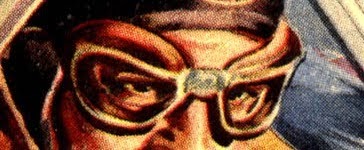
Info About The Spirit:
The
Spirit is a fictional masked crimefighter created by cartoonist
Will Eisner. He first appeared
June 2, 1940 in "The Spirit Section", the colloquial name given to a 16-page
Sunday supplement, distributed to 20 newspapers by the
Register and
Tribune Syndicate and reaching five million readers during the 1940s. From
the 1960s to 1980s, a handful of new Eisner Spirit stories appeared in
Harvey Comics and
elsewhere, and
Warren Publishing and
Kitchen Sink
Press variously reprinted the feature in black-and-white comics magazines
and in color comic books. In the 1990s and 2000s, Kitchen Sink
[clarification
needed] and
DC
Comics published new Spirit stories by other writers and artists.
The Spirit chronicles the adventures of a masked
vigilante who fights crime with the blessing of the
city's police commissioner Dolan, an old friend. Despite the Spirit's origin as
detective Denny Colt, his real identity was virtually unmentioned again, and for
all intents and purposes he was simply "the Spirit". The stories range through a
wide variety of styles, from straightforward
crime drama and
noir to lighthearted adventure,
from
mystery and
horror to
comedy and
love
stories, often with hybrid elements that twisted genre and reader
expectations. Eisner said in an interview that he created the strip as a vehicle
to explore various genres: "When I created The Spirit, I never had any intention
of creating a superhero. I never felt The Spirit would dominate the feature. He
served as a sort of an identity for the strip. The stories were what I was
interested in."
[1]
The feature was the lead item of a 16-page,
tabloid-sized, newsprint comic book sold
as part of eventually 20 Sunday newspapers with a combined circulation of as
many as five million copies. "The Spirit Section", as it was colloquially
called, premiered June 2, 1940, and continued until October 5, 1952. It
generally included two other, four-page strips (initially
Mr. Mystic and
Lady Luck),
plus filler material. Eisner worked as editor, but also wrote and drew most
entries—generally, after the first few months, with such uncredited
collaborators as writer
Jules Feiffer and artists
Jack Cole and
Wally Wood, though with Eisner's
singular vision for the character as a unifying factor.
Publication history
In late 1939,
Everett M. "Busy" Arnold,
publisher of the
Quality Comics comic-book
line, began exploring an expansion into newspaper Sunday supplements, aware that
many newspapers felt they had to compete with the suddenly burgeoning new medium
of
American comic books. Arnold compiled a
presentation piece with existing Quality Comics material. An editor of
The Washington
Star liked
George
Brenner's
The Clock, but not Brenner's art, and was
favorably disposed toward a
Lou
Fine strip. Arnold, concerned over the meticulous Fine's slowness and his
ability to meet deadlines, claimed it was the work of Eisner, Fine's boss at the
Eisner & Iger
studio, from which Arnold bought his outsourced comics work.
In "late '39, just before
Christmas time," Eisner recalled in 1979,
[2] "Arnold came to me
and said that the Sunday newspapers were looking for a way of getting into this
comic book boom". In a 2004 interview, Eisner elaborated on that meeting:
"Busy" invited me up for lunch one day and introduced me to
[sales manager of the Des Moines Register and Tribune Syndicate] Henry Martin,
who said, "The newspapers in this country, particularly the Sunday papers, are
looking to compete with comics books, and they would like to get a comic-book
insert into the newspapers"... Martin asked if I could do it... It meant that
I'd have to leave Eisner & Iger [which] was making money; we were very
profitable at that time and things were going very well. A hard decision.
Anyway, I agreed to do the Sunday comic book and we started discussing the deal
[which] was that we'd be partners in the "Comic Book Section", as they called it
at that time.
[3]
Eisner negotiated an agreement with the syndicate in which Arnold would
copyright
The Spirit, but, "Written down in the contract I had with
'Busy' Arnold — and this contract exists today as the basis for my copyright
ownership — Arnold agreed that it was my property. They agreed that if we had a
split-up in any way, the property would revert to me on that day that happened.
My attorney went to 'Busy' Arnold and his family, and they all signed a release
agreeing that they would not pursue the question of ownership."
[3] This would
include the eventual backup features, "
Mr. Mystic" and "
Lady Luck."
Selling his share of their firm to Iger, who would continue to package comics
as the S. M. Iger Studio and as Phoenix Features through 1955, for $20,000,
[4] Eisner left to
create
The Spirit. "They gave me an adult audience", Eisner said in 1997,
"and I wanted to write better things than superheroes. Comic books were a
ghetto. I sold my part of the enterprise to my associate and then began The
Spirit. They wanted an heroic character, a costumed character. They asked me if
he'd have a costume. And I put a mask on him and said, 'Yes, he has a
costume!'"
[5]
The character and the types of stories Eisner would tell, Eisner said in
1978, derived from his desire
...to do short stories. I always regarded comics as a
legitimate medium, my medium. Creating a detective character would... provide me
with the most viable vehicle for the kind of stories I could best tell. The
syndicate people weren't in full agreement with me... [I]n my first discussion
with 'Busy' Arnold, his thinking centered around a superhero kind of character—a
costumed character; we didn't use the word 'superhero' in those days... and I
argued vehemently against it because I [had] had my bellyful of creating
costumed heroes at Eisner and Iger... [S]o actually one evening, around three in
the morning, I was still working, trying to find it—I only had about a
week-and-a-half or two weeks in which to produce the first issue, the whole deal
was done in quite a rush—and I came up with an outlaw hero, suitable, I felt,
for an adult audience.
[6]
The character's name, he said in that interview, came from Arnold: "When
'Busy' Arnold called, he suggested a kind of ghost or some kind of metaphysical
character. He said, 'How about a thing called the Ghost?' and I said, 'Naw,
that's not any good,' and he said, 'Well, then, call it the Spirit; there's
nothing like that around.' I said, 'Well, I don't know what you mean.,' and he
said, 'Well, you can figure
that out—I just like the words "the Spirit."'
He was calling from a bar somewhere, I think... [A]nd actually, the more I
thought about it the more I realized I didn't care about the name."
[6]
The Spirit, an initially eight- and later seven-page
urban-crimefighter series, ran with the initial backup features "Mr. Mystic" and
"Lady Luck" in a 16-page Sunday supplement (colloquially called "The Spirit
Section") that was eventually distributed in 20 newspapers with a combined
circulation of as many as five million copies.
[7] It premiered June 2,
1940, and continued through 1952.
[8]
Eisner was
drafted into the
U.S. Army in late 1941, "and then
had about another half-year which the government gave me to clean up my affairs
before going off" to fight in
World War II.
[6] In his
absence, the newspaper syndicate used ghost writers and artists to continue the
strip, including
Manly Wade Wellman, William Woolfolk, and
Lou Fine.
[citation
needed]
Eisner's rumpled, masked hero (with his headquarters under the tombstone of
his supposedly deceased true identity, Denny Colt) and his gritty, detailed view
of big-city life (based on Eisner's Jewish upbringing in New York City) both
reflected and influenced the
noir outlook of movies and fiction in the
1940s.
[citation
needed] The strip is notable in that it spun stories of the
little people overlooked in the city's maelstrom.
[citation
needed] In some episodes, the nominal hero makes a brief,
almost incidental appearance while the story focuses on a real-life drama played
out in streets, dilapidated
tenements, and smoke-filled back rooms. Yet along
with
violence and
pathos,
The Spirit lived on
humor, both subtle and overt. He was
machine-gunned,
knocked silly, bruised, often amazed into near immobility and constantly
confused by beautiful women.
[citation
needed]
The feature ended with the October 5, 1952, edition.
[8] As
The Comics
Journal editor-publisher
Gary Groth wrote, "By the late '40s, Eisner's
participation in the strip had dwindled to a largely supervisory role. ...
Eisner hired
Jerry
Grandenetti and
Jim
Dixon to occasionally ink his pencils. By 1950,
[Jules] Feiffer was writing most of the strips,
and Grandenetti, Dixon, and
Al Wenzel
were drawing them."
[9] — Grandenetti
penciling as a
ghost-artist, under Eisner's
byline, said in 2005 that before the feature's demise, Eisner had "tried
everything. Had me penciling 'The Spirit'. Later on it was Wally Wood", who drew
the final installments.
[10]
Fictional character
biography
The Spirit, referred to in one newspaper article cited below as "the only
real middle-class crimefighter", was the hero persona of young detective
Denny Colt. To be precises Dennis Colt Jr. Presumed killed in the first
three pages of the premiere story, Colt later revealed to his friend, Central
City Police Commissioner Dolan, that he had in fact gone into suspended
animation caused by one of archvillain Dr. Cobra's experiments. When Colt
awakened in Wildwood Cemetery, he established a base there and, using his
new-found anonymity, began a life of fighting
crime wearing only a small
domino mask, blue
business suit, red
necktie,
fedora hat, and
gloves for a costume. The
Spirit dispensed
justice with the aide
of his assistant, Ebony White, funding his adventures with the rewards for
capturing villains.
The Spirit was based originally in New York City which soon changed to
Central City, but his adventures took him around the globe. He met up with
eccentrics, kooks, and
femme
fatales, bringing his own form of justice to all of them. The story changed
continually, but certain themes remained constant: the love between the Spirit
and Dolan's feisty
protofeminist daughter Ellen; the annual "
Christmas Spirit" stories; and the
Octopus (a psychopathic criminal
mastermind who was never seen, except for his distinctive gloves).
Ebony White
Eisner is sometimes criticized for his depiction of
Ebony White, the Spirit's
African-American sidekick. The character's name is a
racial
pun, and his facial features, including
large white eyes and thick pinkish lips, are typical of racial
blackface caricatures popular
throughout the "
Jim
Crow" era. Eisner later admitted to consciously stereotyping the character,
but said he tried to do so with "responsibility", and argued that "at the time
humor consisted in our society of bad English and physical difference in
identity".
[11] The character, who
was consistently treated with respect by the strip's fellow cast-members,
developed beyond the stereotype as the series progressed, and Eisner also
introduced such African-American characters as the no-nonsense Detective Grey
who defied popular stereotypes.
In a 1966
New York Herald Tribune feature by
Eisner's former office manager-turned-journalist,
Marilyn
Mercer wrote, "Ebony never drew criticism from Negro groups (in fact, Eisner
was commended by some for using him), perhaps because, although his speech
pattern was early
Minstrel Show, he himself derived from another
literary tradition: he was a combination of
Tom Sawyer and
Penrod, with a touch of
Horatio Alger hero, and
color didn't really come into it".
[12]
The
DC Comics' Spirit
comic-book series of the late 2000s portrays White as a street kid, driving a
stolen taxi.
[citation
needed] He is portrayed as putting his street experience
and his daring attitude to work at the Spirit's service.
[citation
needed]
Other characters
- The Octopus is the archenemy of the Spirit. He is a criminal mastermind
and master of disguise who never shows his real face, though he is identified by
his distinctive gloves. In the second issue of the 1960s Harvey Comics Spirit
comic book, his name is given as Zitzbath Zark. (Vide sitz bath.)
- P'Gell is a femme
fatale who perennially tries to seduce the Spirit to a life of crime at her
side. She seduces and marries wealthy men who invariably die in mysterious ways,
and uses their money to fund her crime empire in Istanbul and expand her influence and control over the
underworld. After moving to Central City to find the Spirit, she
continues her modus
operandi of selected marriages with the creme of society, even gaining an
ally in the form of Saree, the young daughter of one of her deceased husbands.
In the 2000s DC Comics version,
P'Gell was once a young socialite in love with a doctor, working in Third World countries, and
turned to a life of crime when he was killed. P'Gell was ranked 52nd in Comics Buyer's
Guide's 100 Sexiest Women in Comics list.[13]
- Sand Saref is a childhood friend of Denny Colt, and knows he is the
Spirit. Working in espionage, she usually ends up on the opposite side of the
law from him. She appears several times, always involved in some criminal
scheme. (Vide sans serif.) Sand Seref was ranked 73rd in Comics
Buyer's Guide's 100 Sexiest Women in Comics list.[14]
- Silken Floss is a nuclear physicist and a surgeon, who acts as the
accomplice to the Octopus.
- Dr. Cobra is a mad scientist whose chemicals and machinations
inadvertently help Denny Colt become the Spirit.
- Mister Carrion is a morbid con man with a pet vulture, Julia. (Vide carrion.)
- Darling O' Shea is the richest and most spoiled child in the
world.
- Hazel P. Macbeth is a witch with a Shakespearean motif and
apparent magical powers.
- Lorelei Rox, an apparent siren,
appeared in a September 1948 strip and subsequently in 2000s DC Comics Spirit
stories.
- Silk Satin is a tall, statuesque brunette with a white streak in her
hair, originally an adventuress who later reformed and worked as an
international troubleshooter for the insurance company Croyd's of Glasgow. In
later stories, its revealed she has a daughter, Hildie, who motivates her to
stay on the straight path. In the 2000s DC Comics revival, she is a smaller,
more slender, blond CIA
agent. Silk Satin was ranked 72nd in Comics Buyer's Guide's 100 Sexiest
Women in Comics list.[15]
The Spirit and John
Law
Several Spirit stories, such as the first appearance of Sand Saref, were
retooled from a failed publishing venture featuring an
eyepatched,
pipe-smoking detective named
John Law. Law and
his shoeshine-boy sidekick, Nubbin, starred in several adventures planned for a
new comics series. These completed adventures were eventually adapted into
Spirit stories, with John Law's eyepatch being changed to the Spirit's mask, and
Nubbin redrawn as Willum Waif or other Spirit supporting characters.
The original John Law stories were restored and published in
Will Eisner's
John Law: Dead Man Walking (
IDW Publishing, 2004), a collection of stories
that also features new adventures by writer-artist Gary Chaloner, starring John
Law, Nubbin, and other Eisner creations, including
Lady Luck and
Mr. Mystic.
Assistants and
collaborators
Like most artists working in newspaper comic strips, Eisner after a time
employed a studio of assistants who, on any given week's story, might draw or
simply ink backgrounds, ink parts of Eisner's main characters (such as clothing
or shoes), or as eventually occurred, ghost-draw the strip entirely. Eisner also
eventually used ghostwriters, generally in collaboration with him.
Jules Feiffer, who
began as an art assistant circa 1946 and later became the primary writer through
the strip's end in 1952, recalled, "When I first worked for Will there was
John
Spranger, who was his penciler and a wonderful draftsman; better than Will.
There was
Sam
Rosen, the lettering man.
Jerry Grandenetti came a little after me and
did backgrounds, and Jerry had some architectural background. His drawing was
stiff but loosened up after a while, but he drew backgrounds and inked them
beautifully. And
Abe
Kanegson, who was my best friend in the office, was a jack-of-all-trades but
mostly did lettering and backgrounds after Jerry left. Abe was a mentor to
me."
[16]
Eisner's studio also included:
[8][17]
- Art assistants: Bob Powell (1940), Dave Berg
(backgrounds, 1940–41), Tex Blaisdell (1940–41), Fred Kida (1941), Alexander Kostuk a.k.a. Alex Koster
(1941–43), Jack
Cole (1942–43), Jack Keller (backgrounds, 1943), Jules
Feiffer (1946–47), Manny Stallman (1947–49), Andre
LeBlanc (1950), Al Wenzel (1952)
- Ghost artists (pencilers): Lou
Fine and Jack Cole (variously, during Eisner's World War II service,
1942–45), Jerry Grandenetti (1951), Wally Wood (1952)